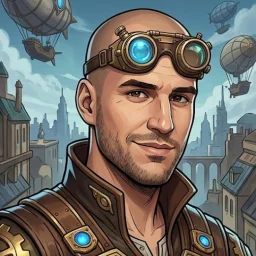
 Bill
Bill 
Over the past three articles, you've met SaxonDragon through the lens of what he's building, what he believes, and what he's learned from years of leading teams who never met in person. Now, in this final installment, you meet the man himself.
We asked him who he is, where he comes from, and how he ended up here. What followed was the longest and most extraordinary answer in the entire interview: a life that moves from wargames on a dining table in Oregon to an Apple II game that predated Elite, from a Play-By-Mail engine still running 35 years later to a college classroom in Michigan where fifty years of accumulated knowledge found its next generation of carriers.
We saved this one for last deliberately. By now you understand what he's built. This is the story of how someone becomes capable of building it.
Who are you, where do you come from, and how did you end up in the world of game creation?
Oregon, imagination, and the first container
My name is Jim Landes, and most people who know me online know me as "Saxondragon".
I grew up in Southern Oregon back when the Pacific Northwest was still a pretty wild and remote place to be a kid, and that environment fed my imagination early. Before I ever rolled a die or booted up a computer, I was writing stories. Fantasy, adventure, worlds that didn't exist yet. That creative itch never really went away; it just kept finding new containers.
The first container was boxed wargames, the kind with hex maps and stacks of cardboard counters that took over the dining room table for days at a time. From there it was a natural step to miniature wargames, where suddenly the armies were three-dimensional and you were painting them yourself. That tactile, world-building aspect pulled me deeper, and before long I found tabletop RPGs.
If wargames taught me systems, roleplaying games taught me narrative, how rules and story could reinforce and elevate each other. And that intersection, I've come to believe, is where the most important breakthroughs happen. The greatest leaps in human understanding rarely occur within a single discipline; they happen at the collision point between two. In this case, the collision was between literature and mathematics, and the result was the roleplaying game.
1974: an eighth-of-a-page ad that changed everything
I discovered RPGs in 1974 from an eighth-of-a-page black and white advertisement in Wargamers Digest. That was all it took. The hobby at that point was essentially a three-box set with no supporting materials, no lore guides, no world maps, aimed squarely at dungeon crawling: get in, fight monsters, get out. But the moment you sat down with that box, a more fundamental question surfaced almost immediately. Where is the dungeon? Why is it here? Who built it, and what happened to them? Those questions didn't have answers yet, because nobody had thought to provide them.
So we provided them ourselves. That was the beginning of the worldbuilding process for me, and I suspect for a lot of game masters of that era, including people like Ed Greenwood, who was doing something remarkably similar in his own basement. Greenwood didn't set out to create one of the most expansive and enduring fantasy settings in the history of the genre. He set out to answer the same questions we were all asking. Who lives here? What do they believe? What happened before the players arrived? The Forgotten Realms began as a private campaign world, built piece by piece the way all honest worldbuilding is done, not from the top down as a grand design, but from the ground up, one answered question leading to three more unanswered ones.
A map tells you where things are. A world tells you why they are.
That's the process that separates a game world from a game map. A map tells you where things are. A world tells you why they are, why the old kingdom fell, why the forest is avoided, why these two cities have hated each other for three generations.
The West Coast circle, and the literature that shaped a generation of game masters
There was a small community of us on the West Coast of the United States who took that responsibility seriously. We weren't content to drop adventurers into a featureless hole in the ground. We built civilizations around the hole. We drew on our own imaginations, yes, but also on the literature that was exciting us at the time.
Katherine Kurtz's Deryni series, with its richly realized medieval world where magic and politics were inseparable. Roger Zelazny's Chronicles of Amber, with its layered, philosophical approach to alternate realities and the nature of power. Tolkien's Middle Earth, which had set the standard for secondary world creation and remains the benchmark against which all fantasy worldbuilding is still measured. Edgar Rice Burroughs' Barsoom series, which taught us that a world needed not just geography but atmosphere, that a reader or a player had to be able to feel the heat of two suns and the thin air of a dying planet. And Robert E. Howard's Conan stories, which demonstrated that a world could be conveyed through action and implication as much as through exposition, that you could make a civilization feel ancient and real without stopping the narrative to explain it.
These weren't just entertainment; they were templates for what a game world could feel like, and between them they covered nearly every dimension of what made a fictional world worth inhabiting: history, politics, myth, atmosphere, and the lived texture of daily life under extraordinary circumstances.
That led us inevitably to history, anthropology, and cultural research. If you were going to build a feudal society that felt authentic, you needed to understand how feudal societies actually worked, their economies, their tensions, their belief systems. The game became the engine for a kind of self-directed education that no classroom had offered me yet.
Playtesting Champions: twenty typewritten pages stapled in the corner
And of course, like every game master worth the title, we modified the base rules constantly. The published systems were starting points, not sacred texts. I developed a number of my own unpublished roleplaying systems over those years, each one an attempt to solve some problem the existing rules couldn't quite handle. That tinkering eventually put me in proximity to the professional side of the industry.
I had the opportunity to help playtest Champions and the Hero Game System before either reached publication. Twenty photocopied, typewritten pages stapled in the corner. That was the entire game at that point. Seeing how something moves from those humble beginnings through iteration to a finished product was an education in itself, and one that has stayed with me ever since. Thank you, George MacDonald.
Horizon Simulations: the studio that almost made it, and the lesson that never left
In 1980 I founded a game development studio called Horizon Simulations, targeting the Apple and Atari home computers that were just beginning to find their way into living rooms across the country. We published a game called Shadow Hawk One, a space trading and combat game that, if I'm being immodest about it, was doing things that wouldn't become widely recognized until Elite arrived several years later. The open-ended structure, the sense of a living universe operating around the player, the tension between commerce and conflict, we were exploring that territory early. For a small independent studio in 1980, it was genuinely ambitious work.
But ambition and timing are two different things, and the games industry has always been brutally unforgiving of the gap between them. We missed the critical Christmas sales window, and in a business where that seasonal spike could mean the difference between survival and collapse, the studio ran out of money and folded. It was a hard lesson, and an expensive one, but it was also a masterclass in every aspect of game development that nobody talks about in the design documents: production schedules, market timing, cash flow, and the uncomfortable reality that a great game released too late is, commercially speaking, no game at all. I carried those lessons forward for the rest of my career.
A great game released too late is, commercially speaking, no game at all.
The PBM years, and a modding engine before modding had a name
It was after that experience that I turned to the Play-By-Mail gaming community. PBM, for the uninitiated. Not as a player, but as a founder. I established a PBM company and created two products that I'm proud of to this day. The first was Epic, and the second was the Legends game system, and it is Legends that, in retrospect, I consider one of the most forward-thinking things I ever built.
Legends was a completely data-driven PBM engine, designed to create and run entirely different games using a standard set of orders as its foundation. The engine itself was the product. The worlds and the rules that ran inside it were interchangeable, buildable, and modifiable by design. If that sounds familiar to anyone who has spent time in modern modding communities, it should. Legends was doing in the PBM space what modding tools would later do for video games: putting the power of world creation into the hands of the people running the games, rather than locking it inside the software. It was a modding engine before modding had a name.
The most remarkable part of that story is that Legends never really stopped. The game is still running today, 35 years later, maintained and operated by a small company in England called Harlequin Games. A system conceived and built in the early days of home computing, still generating games, still serving players, decades later. That kind of longevity doesn't happen by accident. It happens when the architecture of something is fundamentally sound.
Two degrees, a decade in B2B, and what they taught about human beings
Real life intervened in ways that had nothing to do with games, the kind of personal events that have a way of resetting your priorities and forcing you to look at everything differently. I sold the company and stepped away from game development entirely.
Going back to college was both a practical decision and, I think, a way of rebuilding from a solid foundation. I earned two degrees, one in Psychology and one in Computer Science. On the surface they might seem like an odd pairing, but for someone who had spent years thinking about why people play games and how the systems underlying them work, they turned out to be exactly the right lenses. Psychology gave me a framework for understanding player motivation, decision-making, and the emotional architecture of engagement. Computer Science gave me the technical vocabulary to stop approximating what I wanted to build and start specifying it precisely.
That combination of skills led to a decade in product marketing in the B2B software space, which sounds like a hard left turn away from game development, and in some ways it was. But marketing teaches you something fundamental: you have to understand what people want before you can give them something they didn't know they needed. That's not entirely different from game design. In many ways, it's exactly the same problem wearing a different set of clothes.
The economic downturn, the honest question, and the answer that came quickly
Then the economic downturn hit, and the mass layoffs that followed gave me an unexpected gift in the form of a question I had to answer honestly: what do I actually want to do? The answer came quickly. I wanted to get back into interactive entertainment. But wanting back in and getting back in are two different things, especially after such a long absence. I needed to demonstrate that my skills hadn't calcified, that I still understood how games were built, how communities formed around them, and how worlds were made to feel alive.
That need is where modding entered the picture, and honestly, that's where the game creation bug bit hardest. Taking an existing game world and reshaping it, adding lore, mechanics, and content, felt like the most direct expression of everything I'd been doing since those early stories in Oregon. It's collaborative, it's iterative, and it's deeply satisfying when players engage with what you've built.
That need is where Prophesy of Pendor was born. I chose Mount & Blade as my canvas because it was a game with extraordinary bones and a modding community that rewarded careful craft. The mod grew well beyond what I had initially imagined, developing its own lore, its own factions, its own sense of history.
Teaching as legacy: putting 50 years directly into other people's hands
What opened up next was something I hadn't fully anticipated: the opportunity to teach game design and software development at a college in Michigan. But I want to be clear about what teaching meant to me, because it was never simply about standing at the front of a classroom and transferring information.
It was about legacy. It was about taking fifty years of hard-won experience, the failed studio, the missed Christmas window, the PBM engine that outlived the company that built it, the lessons learned from every system I had ever designed and every world I had ever built, and putting all of that directly into the hands of people who could do more with it than I had been able to do alone. Every developer and artist who came through those programs was a multiplier. What I knew, they could take further. What I had attempted, they could complete.
The knowledge that the work continues through other people, in directions you couldn't have reached by yourself.

And teaching, for me, was never just teaching. It was the chance to build something alongside it. During those years we created a student-powered, real-world project called Starium XCV, a web-based space exploration game designed specifically for people who love games but no longer have the hours to dedicate to them. What began as a classroom project became something much larger over time. Fifteen years of part-time development, successive waves of students contributing their skills, and a vision that never wavered has brought us to where we are now: a small, dedicated team finishing up the final coding, with a release planned for early next year.
Retirement eventually brought me east to Connecticut, and with it a new chapter, working on game development with a team that spans multiple time zones and continents. The geography has changed, the technology has changed, and the tools have changed beyond anything I could have imagined sitting at that folding table in 1974 with a box of rules and a head full of questions.
But the questions themselves? Those haven't changed at all.
Which games have shaped you most as a creator? What made you want to make games rather than just play them?
Not TSR modules: the sandbox
The honest answer is roleplaying games, but I need to be precise about what that means, because not all roleplaying games shaped me equally, and the distinction matters.
TSR produced modules. Scenarios. Pre-written adventures with a beginning, a middle, and an end, where the story was already determined and the players were essentially tourists moving through someone else's narrative. Those had their place, and I don't dismiss them. But they weren't what formed me as a creator. What formed me was something fundamentally different: the sandbox.
The campaigns that changed how I thought about games, about worlds, about what interactive storytelling could actually be, were set in low fantasy medieval worlds with no predetermined destination. No scripted villain to defeat, no artifact to retrieve, no final door with a boss behind it. Just a world, operating according to its own internal logic, and characters finding their place within it. You could go anywhere. You could do anything. And the consequences of your choices rippled outward in ways that felt absolutely real, because a good game master made sure they did.
Grand tactical roleplaying: when the hero becomes the ruler
What made those campaigns extraordinary was what happened at the far end of the character progression arc. Most people think of roleplaying games as personal stories, one hero, one journey. But in the campaigns I ran and played in, characters who reached sufficiently high levels underwent a transformation. The scale shifted. Suddenly you weren't just a warrior or a wizard navigating a dungeon. You were a lord, a warlord, a high priest. You were building temples and fortifying castles. You were negotiating alliances, funding armies, managing the economies of territories that depended on your decisions. You were establishing kingdoms, or dismantling the ones that stood in your way.
It was, without anyone quite labeling it at the time, grand tactical roleplaying. The personal and the political, the intimate and the epic, existing on a continuous spectrum within the same campaign. A character who started as a street-level adventurer could end up reshaping the political geography of an entire continent, and every step of that journey was earned, documented, and consequential.
That model never left me. In many ways it is still the game I am trying to build on a computer.
That model never left me. In many ways it is still the game I am trying to build on a computer. The seamless progression from individual agency to civilizational consequence, from the single sword in a single hand to the armies that sword eventually commands, that is the design problem I keep returning to. Technology has changed enormously since those folding-table campaigns in the 1970s. The fundamental aspiration hasn't moved an inch.
The line between player and creator, and why it dissolved early
As for why I wanted to make games rather than just play them, I think the answer was already embedded in those campaigns. The moment you sit down as a game master and realize that you are not just facilitating someone else's fun but actively constructing a world that responds, breathes, and surprises even you, the line between player and creator dissolves. I crossed that line very early, and I never really crossed back.
A final word from TomeHero
Four articles. Four weeks. One extraordinary mind.
When SaxonDragon says the questions haven't changed since 1974, you believe him, because you've now read fifty years of evidence. The failed studio. The engine still running in England. The classroom in Michigan. The mod that a retired developer built to prove to himself that he still could, which became one of the most beloved game experiences of its era.
Prophesy of Pendor 2 isn't just a game in development. It's the destination of a very long journey. We're glad we got to document part of it, and we'll be watching closely for what comes next.
Follow the project on Discord and official website.
This is part 4 of a 4-part exclusive interview with SaxonDragon :
©Photo credit: Dungeons and Dragons 1974 art