The Legend of Zelda
The first Zelda came out of a cave. Shigeru Miyamoto spent his childhood exploring the hills near Kyoto, walked into one with a lantern without knowing what was inside, and built a game around that in 1986. The series has rewritten its own rules twice since, and both times the rest of the industry followed within five years.
A cave near Kyoto, then a map with no arrows on it
Miyamoto grew up in Sonobe and spent his childhood exploring fields, woods and one cave he entered with a lantern. He designed the first game around that feeling: a world handed to the player without instructions.
The Legend of Zelda: A Link to the Past set the template in 1991, with two overlapping worlds and a structure of locks and keys that the series reused for a decade.
The Legend of Zelda: Link's Awakening followed on a handheld in 1993, with no Ganon, no Hyrule and an ending that undoes its own setting.
Ocarina of Time still holds the highest score Metacritic has recorded
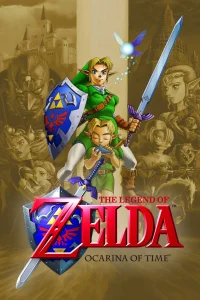
The Legend of Zelda: Ocarina of Time arrived in 1998 and had to invent how three-dimensional combat works. Its answer, locking the camera onto an enemy and circling it, is now in almost every action game made.
It holds 99 on Metacritic, the highest average the site has ever recorded for a game. Nintendo then made The Legend of Zelda: Majora's Mask in one year by reusing that engine, and built it around a three-day cycle that resets everything the player has done.
The Legend of Zelda: The Wind Waker was rejected on sight in 2002 for its cartoon look, then reassessed as one of the best in the series. The Legend of Zelda: Twilight Princess answered the complaint in 2006 with a darker tone, and The Legend of Zelda: Skyward Sword pushed the guided structure as far as it could go in 2011.
Breath of the Wild deletes the rulebook in 2017
The Legend of Zelda: Breath of the Wild removed the locks, the order and most of the instructions. Players could walk to the final boss in under an hour. It scored 97 on Metacritic and sold more than 32 million copies.
Within five years, open-world games across the industry had copied its climbing, its stamina meter and its refusal to mark the map. Elden Ring and Genshin Impact both took visible pieces of it.
The Legend of Zelda: Tears of the Kingdom went further in 2023 by letting players glue objects together, which produced machines Nintendo had not planned for and could not have tested.
Forty years without a fixed continuity
Nintendo published an official timeline in 2011 that splits into three branches, one of which depends on the player losing. It settled nothing, and the company has treated its own chronology loosely ever since.
What holds the series together is a set of objects rather than a story: a sword, a shield, an ocarina, a green tunic. Each game rebuilds the world around them and expects the player to recognise the furniture.
That is a rare arrangement. Most long-running series protect their continuity; this one protects its inventory.
All works
No work matches this filter.