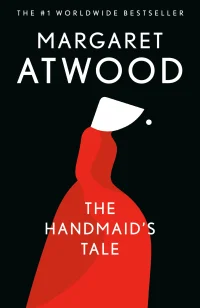
The Handmaid's Tale
Margaret Atwood set herself a rule while writing: nothing in the book could be invented. Every restriction placed on women in Gilead had happened somewhere, to someone, at some point in recorded history. That constraint is why the novel keeps returning to the news thirty years after publication.
1985: a novel with a research file
Atwood began the book in West Berlin in 1984 and kept a file of newspaper clippings to justify each element: forced births, book bans, public executions, seizure of women's bank accounts.
The narrator has no name of her own. She is Offred, meaning she belongs to a man called Fred, and the grammar of the name is the argument of the novel.
The novel has sold more than eight million copies in English alone. It was published as literary fiction rather than science fiction, a distinction Atwood has defended and complicated for forty years, on the grounds that speculative fiction describes what could happen rather than what could not.
The costume leaves the book
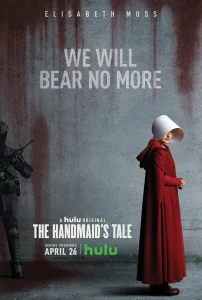
The red cloak and white bonnet were designed for the 1990 film and refined for the 2017 series. They are now a protest uniform.
Women in that costume have appeared in legislative chambers in the United States, Ireland, Argentina, Poland and Croatia, standing silently during debates on abortion law. The garment works because it is recognisable at a distance and requires no explanation.
No other adaptation has produced a piece of political clothing at that scale, and Atwood did not design it. She has said she finds the sight of it both gratifying and alarming.
An adaptation that outran its source and then waited
Handmaid's Tale reached television in 2017 and covered the novel in one season. It then continued for five more, inventing everything after the first.
The first season took eight Emmy Awards, including best drama, the first for a streaming service. The later seasons divided viewers over how far a story built on confinement can be extended.
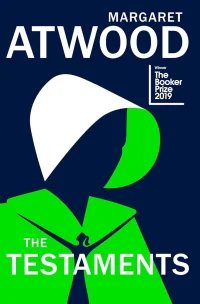
Atwood published The Testaments in 2019, set fifteen years later and written partly in answer to the questions readers had asked for three decades about how Gilead ends. It won the Booker Prize.
A book that keeps being banned by the people it describes
The novel is among the most frequently challenged in American school libraries, and the objections cite the sexual content of scenes written to depict coercion.
Atwood responded in 2022 by producing an unburnable edition, printed on fireproof material, auctioned for a free speech organisation. It sold for 130 000 dollars.
A book assembled entirely from historical fact is removed from shelves for describing that fact, which is close to the shortest demonstration of its own thesis a novel could hope for.
All works
No work matches this filter.