
Star Trek III: The Search for Spock

Star Trek III: The Search for Spock

Movie
ComposerJames Horner
+4
Balance
+4 -0
Score weighted by each hero's level: a recommendation from a level 3 hero counts for 3.
4.0/5
1
Reviews
Tome
From the editors, by Tome Updated on 24/09/2026

Directed by the man the studio thought wanted Spock dead

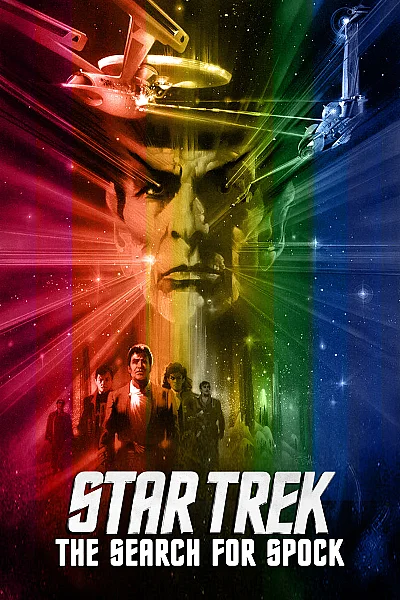
Studio chief Michael Eisner hesitated to hire Leonard Nimoy, wrongly believing the actor hated Star Trek and had demanded in his contract that Spock be killed. Nimoy persuaded him otherwise and became the first member of the Star Trek cast to direct one of the films. Gene Roddenberry said Harve Bennett had hired a director he could not fire.

Nimoy wanted the Klingon bird of prey to recall an attacking bird, with movable wings that change between cruising and attack positions. The destruction of the Enterprise was filmed with cheaper models rather than the original, worth 150,000 dollars, including a Styrofoam model dissolved with acetone. James Horner adapted music from Sergei Prokofiev's Romeo and Juliet for part of the ship's theft and destruction.

The Story

The Enterprise limps back to Earth, Spock's casket has landed on the planet created by the Genesis device, and McCoy begins to act strangely. Kirk and Sarek, Spock's father, learn that Spock transferred his katra, his living spirit, to McCoy before dying, and that the katra and body are needed to lay him to rest on Vulcan. Kirk and his officers steal the Enterprise to return to the Genesis planet, while a Klingon commander, Kruge, wants the secrets of Genesis as a weapon.

Harve Bennett wrote the script backwards from its ending, in six weeks. The scripts were chemically treated so that any copy could be traced, and Spock appeared in them as Nacluv, Vulcan spelled backwards. Word of the Enterprise's destruction leaked out before release.

The Ideal Audience

The film opened in North America on 1 June 1984, the same summer as Gremlins and Ghostbusters. It is the middle part of a three-film story, from Star Trek II: The Wrath of Khan to Star Trek IV: The Voyage Home, and we would not start here.

Common Sense Media recommends it from age ten, citing starship battles and hand-to-hand combat with casualties. Gary Arnold, in the Washington Post, wrote that Nimoy concentrates on the actors in ways that flatter and enhance their work, which is why we would watch it.

+4
Balance
+4 -0
Score weighted by each hero's level: a recommendation from a level 3 hero counts for 3.
4.0/5
1
Reviews
Tome
From the editors, by Tome Updated on 24/09/2026

Directed by the man the studio thought wanted Spock dead

Studio chief Michael Eisner hesitated to hire Leonard Nimoy, wrongly believing the actor hated Star Trek and had demanded in his contract that Spock be killed. Nimoy persuaded him otherwise and became the first member of the Star Trek cast to direct one of the films. Gene Roddenberry said Harve Bennett had hired a director he could not fire.

Nimoy wanted the Klingon bird of prey to recall an attacking bird, with movable wings that change between cruising and attack positions. The destruction of the Enterprise was filmed with cheaper models rather than the original, worth 150,000 dollars, including a Styrofoam model dissolved with acetone. James Horner adapted music from Sergei Prokofiev's Romeo and Juliet for part of the ship's theft and destruction.

The Story

The Enterprise limps back to Earth, Spock's casket has landed on the planet created by the Genesis device, and McCoy begins to act strangely. Kirk and Sarek, Spock's father, learn that Spock transferred his katra, his living spirit, to McCoy before dying, and that the katra and body are needed to lay him to rest on Vulcan. Kirk and his officers steal the Enterprise to return to the Genesis planet, while a Klingon commander, Kruge, wants the secrets of Genesis as a weapon.

Harve Bennett wrote the script backwards from its ending, in six weeks. The scripts were chemically treated so that any copy could be traced, and Spock appeared in them as Nacluv, Vulcan spelled backwards. Word of the Enterprise's destruction leaked out before release.

The Ideal Audience

The film opened in North America on 1 June 1984, the same summer as Gremlins and Ghostbusters. It is the middle part of a three-film story, from Star Trek II: The Wrath of Khan to Star Trek IV: The Voyage Home, and we would not start here.

Common Sense Media recommends it from age ten, citing starship battles and hand-to-hand combat with casualties. Gary Arnold, in the Washington Post, wrote that Nimoy concentrates on the actors in ways that flatter and enhance their work, which is why we would watch it.

Status: Completed
Publication: 1984
Country of origin: United States
Original language: English
Age rating: Teen (13+)
Genres: Science Fiction Space Opera Adventure

Also in the Star Trek universe

See all 15 works

Reviews

Coolartist1110

The Spirk Movie

People tend to compare this one with its predecessor, Wrath of Khan, and treat it harshly because it's not quite as good. I, personally, think that's kinda unfair. I do think the movie's weaker, yes, but you're comparing it to what most people consider the best film the franchise ever gave us. It's not that bad!

The way they resurrected Spock's body is slightly contrived, I'll give you that. But come on. We all knew he wasn't gonna stay dead. They weren't gonna kill off the most iconic character in the history of the series. And honestly, my favorite part of the movie is how they kept his mind intact. Seeing Bones act like Spock was really fun, and Kelley did a phenomenal job.

This movie is probably best suited for people who (like myself) care a lot about Kirk and Spock's relationship. Do I (and SO MANY OTHER PEOPLE) think that relationship happens to be romantic in nature? Yes. Does the movie still work if you view them as the bestest of friends? Also yes! Kirk's dedication to the man closest to him is the driving force behind the whole movie. If you don't care about their relationship (regardless of how you view it), you won't care about this movie.

I don't know if it's Shatner's best performance, but, to me, it seems like his most genuine. Even with the iconic "KHAN!" scream from the last movie, it was still really, well, BIG. Y'know, like most of his performances. But in this one, there are so many smaller, underplayed moments of emotional vulnerability. That's not something I usually associate with him. I was impressed.

It's got its weaknesses, like the Klingons not being the best villains in this one (Christopher Lloyd did great though!). But if you stop comparing it to Wrath of Khan all the time, it's a pretty good watch.
Recommends:
+4 The value of a recommendation depends on its author's level.
Overall
8
Compete in the Heroes' Tournament and win Amazon gift cards! Discover