
Star Trek: The Animated Series

Star Trek: The Animated Series

Animated Series 2 seasons
+4
Balance
+4 -0
Score weighted by each hero's level: a recommendation from a level 3 hero counts for 3.
3.0/5
1
Reviews
Tome
From the editors, by Tome Updated on 29/09/2026

A cast too costly for the animation, aliens too costly for live action

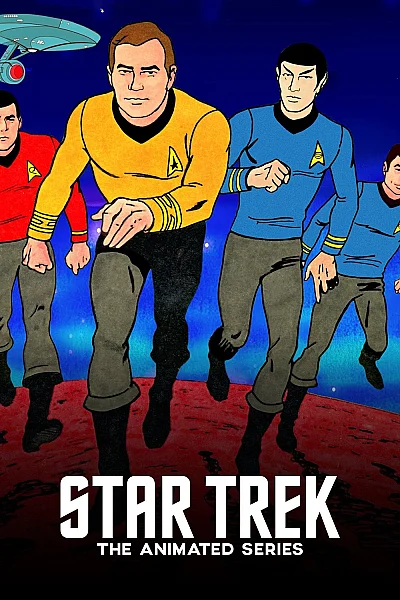
Hiring nearly the whole original cast left little money for the drawings, so Filmation saved where it could: reused footage, characters in silhouette, a hand raised to the mouth so the lips did not have to move. The animators traced the Enterprise and the crew from 35 mm footage of the live-action series. The deal guaranteed 22 episodes over two seasons, at 75,000 dollars each.

Money was a problem at the recording sessions too. Filmation first planned to have James Doohan and Majel Barrett voice Sulu and Uhura, until Leonard Nimoy refused to record Spock unless George Takei and Nichelle Nichols were hired, and both were. Walter Koenig was left out and Chekov does not appear, but Koenig wrote the episode "The Infinite Vulcan".

The Story

In the 23rd century, Captain Kirk commands the USS Enterprise, a Starfleet ship exploring the galaxy for the United Federation of Planets. The bridge gains two crew members: Arex, a navigator with three arms and three legs, and M'Ress, a communications officer who looks like a cat. According to Gene Roddenberry, a live-action series of the time could not have afforded either species.

Writers David Gerrold and D.C. Fontana describe the show as effectively a fourth season of the original series. Gerrold wrote a sequel to his own episode "The Trouble with Tribbles", Fontana sent Spock back in time to his own childhood, and Larry Niven adapted his short story "The Soft Weapon".

The Ideal Audience

Each episode runs about 24 minutes, and NBC aired them on Saturday mornings from 1973 to 1974. Fontana kept the romantic and sexual elements of the original series out, because she wanted to reach children as well as adults, and the ratings were high, but the show was more popular with adults and older children than with young children. The second season won the 1975 Daytime Emmy for Outstanding Entertainment, Children's Series, the first Emmy for any Star Trek series.

+4
Balance
+4 -0
Score weighted by each hero's level: a recommendation from a level 3 hero counts for 3.
3.0/5
1
Reviews
Tome
From the editors, by Tome Updated on 29/09/2026

A cast too costly for the animation, aliens too costly for live action

Hiring nearly the whole original cast left little money for the drawings, so Filmation saved where it could: reused footage, characters in silhouette, a hand raised to the mouth so the lips did not have to move. The animators traced the Enterprise and the crew from 35 mm footage of the live-action series. The deal guaranteed 22 episodes over two seasons, at 75,000 dollars each.

Money was a problem at the recording sessions too. Filmation first planned to have James Doohan and Majel Barrett voice Sulu and Uhura, until Leonard Nimoy refused to record Spock unless George Takei and Nichelle Nichols were hired, and both were. Walter Koenig was left out and Chekov does not appear, but Koenig wrote the episode "The Infinite Vulcan".

The Story

In the 23rd century, Captain Kirk commands the USS Enterprise, a Starfleet ship exploring the galaxy for the United Federation of Planets. The bridge gains two crew members: Arex, a navigator with three arms and three legs, and M'Ress, a communications officer who looks like a cat. According to Gene Roddenberry, a live-action series of the time could not have afforded either species.

Writers David Gerrold and D.C. Fontana describe the show as effectively a fourth season of the original series. Gerrold wrote a sequel to his own episode "The Trouble with Tribbles", Fontana sent Spock back in time to his own childhood, and Larry Niven adapted his short story "The Soft Weapon".

The Ideal Audience

Each episode runs about 24 minutes, and NBC aired them on Saturday mornings from 1973 to 1974. Fontana kept the romantic and sexual elements of the original series out, because she wanted to reach children as well as adults, and the ratings were high, but the show was more popular with adults and older children than with young children. The second season won the 1975 Daytime Emmy for Outstanding Entertainment, Children's Series, the first Emmy for any Star Trek series.

Status: Completed
Publication: 1973 - 1974
Country of origin: United States
Original language: English
Genres: Science Fiction Adventure

Also in the Star Trek universe

See all 15 works

Reviews

Coolartist1110

Insanely Silly

The first thing you need to know about this series is that you should not expect high quality animation. Though some of the character designs are genuinely interesting, the actual animation itself is something I'd compare to He-Man if the budget was even lower. Mind you, that does lead to a lot of very amusing close-up shots of the characters and some great reaction images.

Once you get past that, the show here is...well, Star Trek TOS. It is nice to see some of the stories and ideas they were able to pull off without the limits of practical effects at the time. More aliens actually look like aliens, rather than humans with a singular feature changed. The settings could be more varied. This is the show that introduced the idea of the Holodeck for the first time! I do enjoy the creativity the series shows off.

The cast of the original series, minus Chekhov, all return to reprise their roles. Other than them, the majority of the voice cast is James Doohan (Scotty) and Majel Barrett-Roddenberry (Chapel, The Computer, Number One, and Lwaxana Troi). For a show like this, I think they both do well.

Sometimes you could see some of that TOS philosophical debate in there, but it's mostly just silly. If you like the campier episodes of TOS, you'll probably enjoy this as much as I did. If you're looking for more serious Trek, avoid this show like the plague.

I don't usually do episode recommendations, but I'll make an exception here. Yesteryear, The Ambergris Element, and The Eye of the Beholder are as close to good, serious episodes as I think it gets. Watch More Tribbles More Troubles, The Infinite Vulcan, Once Upon a Planet, The Magicks of Megas-Tu, and The Counter-Clock incident for more funny ones.
Recommends:
+4 The value of a recommendation depends on its author's level.
Overall
10
Compete in the Heroes' Tournament and win Amazon gift cards! Discover