Re-Animator
Lovecraft hated the story. He wrote Herbert West-Reanimator in 1922 as a serial for a magazine that paid by the instalment, called it hackwork and refused to let it be reprinted properly. It is the source of his most successful adaptation.
A serial its author wrote for the money
Lovecraft was paid five dollars per episode and had to recap the plot each time, which he considered ruinous to the prose. He described the result as his worst work.
The story is also unusual in his catalogue for what it does not contain: no cosmic indifference, no unnameable geometry, just a medical student who reanimates corpses and gets steadily worse results.
That plainness is what made it filmable. The rest of Lovecraft resists adaptation because the horror is in what cannot be described, and a camera describes everything.
1985: a film released without a rating
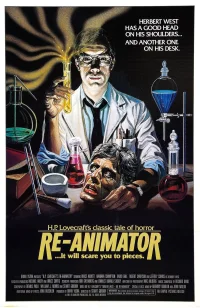
Stuart Gordon shot Re-Animator on about 900 000 dollars, with Jeffrey Combs as Herbert West playing the part entirely straight while the film around him is a comedy.
The American ratings board would have given it an X, which at the time made a film unbookable in most cinemas. Gordon released it unrated instead and lost some venues anyway.
The film made about two million dollars in cinemas and became a rental staple, which was the only route available to it. It was reviewed seriously. Roger Ebert defended it, and it holds a critical standing almost no film of its budget and content has achieved.
Two sequels across eighteen years
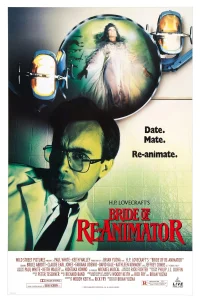
Bride of Re-Animator followed in 1990, released directly to video rental, with the same lead and a plot assembled from body parts, which is at least honest about its method.
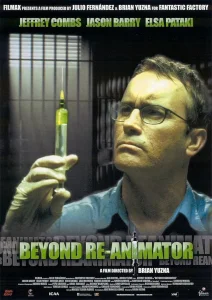
Beyond Re-Animator arrived in 2003, shot in Spain, moving the character to a prison. Combs has now played Herbert West for eighteen years across three films made by three different production arrangements.
A fourth has been announced repeatedly since 2010 and has not been made. Gordon died in 2020, having spent his career adapting Lovecraft, mostly the stories nobody else wanted.
Why this adaptation worked when the others did not
Lovecraft's better stories have defeated stronger directors. The material resists because its effect depends on withholding the image, and film is obliged to supply one.
Re-Animator succeeds by dropping the cosmic register entirely and treating the premise as farce with real consequences, which is the register the original serial was already in.
Gordon and Combs went on to make four more Lovecraft films together. The lesson their first one leaves is uncomfortable for adaptation generally: the text an author dismissed as commercial work translated cleanly, and the texts he valued have produced forty years of failures.
All works
No work matches this filter.