Alien
The script specified that every part was unisex and could be cast either way. That single line turned Ripley into a woman, produced the most copied female lead in film, and it was written for convenience rather than for principle.
A painter the studio found obscene
Dan O'Bannon brought Ridley Scott a book by H. R. Giger, a Swiss painter working in airbrushed biomechanics. Twentieth Century Fox objected to the designs on the grounds that they were sexual, which they are, deliberately.
Giger built the creature and the derelict ship himself, in a studio, using bones and industrial parts. The film won the Academy Award for visual effects in 1980.
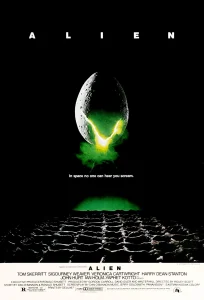
Alien opened in 1979 and was marketed as horror, not science fiction. The structure is a haunted house: a crew in a corridor, one by one. It cost eleven million dollars and took more than a hundred and eighty.
Aliens turns a horror film into a war film
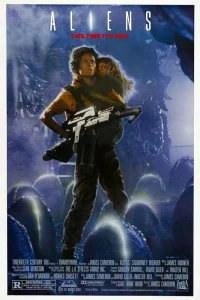
James Cameron took over in 1986 and changed the genre rather than the world. One creature became hundreds, the crew became marines, and the film moves at the opposite speed to its predecessor.
Sigourney Weaver was nominated for an Academy Award for it, which had not happened for a science-fiction performance before and rarely has since.
The two films together set a pattern the franchise has never resolved: each new director changes the genre, and the audience arrives expecting the version they preferred. Six more films have followed, and the argument about which of the first two is the real one has outlasted all of them.
A creature designed to be unwatchable
Giger's design works because it refuses to resolve: the head has no eyes, the mouth contains a second mouth, and the proportions read as skeletal and sexual at once.
Scott shot it in fragments, in darkness, for a total of about four minutes of screen time. The later films show it more, and it becomes less effective each time, which is the clearest lesson the franchise offers and the one it keeps ignoring.
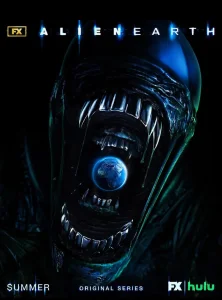
Alien: Earth brought the creature to television in 2025, on Earth for the first time, in a series built by Noah Hawley.
The corridor everyone else copied
The first film established a whole visual grammar for working-class science fiction: industrial interiors, sweat, crews who argue about pay, and a company that regards them as expendable.
Games took it further than films did. Half of the survival horror genre and most of Dead Space are built on those corridors, and Alien: Isolation reproduced the 1979 set design down to the cathode screens.
The creature has a name in the fiction that almost nobody uses. Forty-five years on, it is still just the alien.
All works
No work matches this filter.