Ace Attorney
The localisation moved the country. Phoenix Wright: Ace Attorney is set in Japan, in a Japanese legal system, and the English version relocated it to Los Angeles while keeping the festivals, the food and the samurai television shows. The contradiction became part of what people like about it.
2001: a courtroom game nobody expected to export
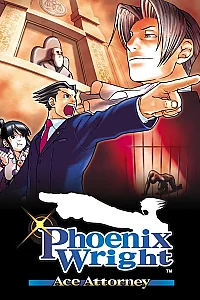
Shu Takumi made the first game at Capcom for the Game Boy Advance, aimed at a domestic audience and a small one. It is a game about reading testimony and finding the sentence that cannot be true.
The structure alternates: an investigation where the player collects objects and statements, then a trial where those objects are used to break a witness.
Japan's system provided the premise. Trials there end in conviction in the overwhelming majority of cases, which is why the games open with the defence already losing and why the protagonist's job looks impossible.
Four years, one touchscreen, and a Western release
Capcom did not export the game. It reached the West in 2005 on the Nintendo DS, four years late, after fan interest and because the touchscreen gave a reason to reissue it.
The translation team relocated everything to California and left the Japanese cultural furniture in place. A prosecutor eats noodles, a television show features a steel samurai, and a character explains that Los Angeles has a Japanese quarter.
Later entries stopped pretending. One game is set explicitly in Japan, which required the series to admit what its own maps had shown for a decade.
Two more trials, and a genre that did not exist in English
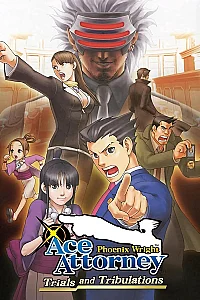
Phoenix Wright: Ace Attorney - Justice for All followed in 2006 and Phoenix Wright: Ace Attorney - Trials and Tribulations in 2007, the third closing a plot the first two had been building since 2001.
Trials and Tribulations is the entry most players rank first, largely because its final case resolves a story the series had left running for three games.
The trilogy has been reissued on nine platforms since, which for a text-heavy game from 2001 is unusual persistence. Western publishers had no equivalent product. Visual novels barely existed in English, and this series is the reason a market for them opened at all.
What a shouted objection did to a genre
The games are almost entirely text. Their appeal is a rhythm: a witness lies, the player finds the contradiction, and the game rewards it with an animation and a shout.
That loop has been copied widely, and the Ace Attorney structure sits under a generation of narrative games where the mechanic is paying attention rather than moving.
A game about reading carefully, made for one country, exported by accident, ended up teaching an English-speaking audience to buy visual novels.
All works

No work matches this filter.