A story told aloud to executives, stopped after two of its five planned parts
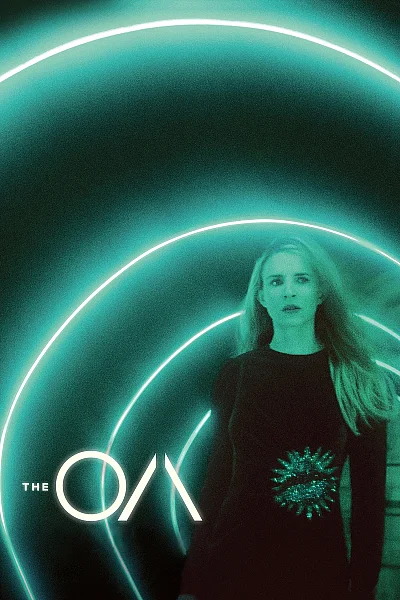
Executives who read the script of the first hour asked whether the story really went somewhere. Brit Marling and Zal Batmanglij, who had been developing it together since December 2012, answered by telling it from beginning to end, playing every character over many hours. After a bidding war between several networks, Netflix ordered eight one-hour episodes in March 2015.
Batmanglij directed nearly all the episodes, and his brother Rostam Batmanglij wrote the theme music. The choreographer Ryan Heffington created the Movements, a choreography inspired by interpretive dance.
The Story
Prairie Johnson comes home after seven years missing. She was blind when she disappeared and can now see, calls herself the OA and refuses to tell the FBI or her adoptive parents where she has been. She meets four high school students and their teacher in an abandoned house at night and tells them her story, starting with her birth in Russia as Nina Azarova.
That story leads to Hap, a scientist played by Jason Isaacs, who studied people who had near-death experiences and locked her in a glass cage in his basement with other test subjects. The OA asks her five listeners to help her open a portal to another dimension to save the others. The second part follows her to San Francisco, in another dimension, where she crosses paths with the private investigator Karim Washington, played by Kingsley Ben-Adir.
The Ideal Audience
Netflix released the first eight episodes in December 2016 and eight more in March 2019, then cancelled the series in August 2019 on a cliffhanger, while its creators had planned five parts. Fans answered with a #SaveTheOA campaign, videos of themselves performing the Movements and a digital billboard in Times Square.
Common Sense Media recommends it from age 16, citing drowning and killings with visible blood, nudity and visible sexual activity, strong language and an attempted poisoning. Rotten Tomatoes counted 92 percent positive reviews among 38 critics for the second part, and we would recommend the series to viewers ready to accept an unresolved ending.


Comments
Log in to join the discussion
No comments yet. Be the first to share your thoughts!