 Bill
Bill 
Six seasons. Nine books. Three never adapted. If you watched The Expanse all the way through, you know exactly what that number feels like. Naren Shankar, Daniel Abraham, and Ty Franck haven't forgotten either.
Their answer is The Captive's War. In development at Amazon MGM Studios and announced in November 2024, the series is based on The Mercy of Gods, the first book in a new trilogy by James S.A. Corey. Same team, different universe, same ambitions. On paper, that's reassuring. On paper only.
The Opposite Problem
Adapting The Expanse was an exercise in subtraction. Nine dense novels, dozens of memorable characters, rigorous orbital mechanics. The challenge was cutting without breaking anything.
The Mercy of Gods flips that problem entirely. The worldbuilding has been widely praised. The Carryx, an interstellar insectoid empire built on hive structure, biological castes, a throne world, and captive species locked in Darwinian competition for survival, is dense, coherent, and genuinely original. The recurring criticism, though, lands somewhere else entirely.
On Goodreads, Reddit, ResetEra, and across genre press, the verdict keeps coming back with unsettling consistency: the characters are bland, interchangeable, and hard to tell apart. A lot of readers never finished the book. The adaptation will need to add what's missing, not cut what isn't.
What the Book Built
The humans of Anjiin have no connection to Earth. A distant world, a civilization completely unprepared for what's coming, no military infrastructure to speak of. The Carryx arrive, abduct the best scientists, and transport them to their throne world. The mission: serve as biological researchers, competing against other captive species. Extinction is the price of failure.
Abraham and Franck have described their own book as "the disappointing child of Frank Herbert and Ursula Le Guin." They cite Viktor Frankl and Hannah Arendt. Their stated inspiration is the Book of Daniel: a small agrarian people torn from their world by an overwhelming military force, compelled to serve their conquerors while working to destroy them from within.
The Captive's War is not a spin-off of The Expanse. The authors describe it as a "different part of the genre," not a shared universe. But they've remained deliberately vague. Whether it connects to the Dark Gods from the three final novels that never got adapted remains an open question.
The Exception That Proves the Rule: Dafyd Alkhor
There is one character who rises above the general flatness. Dafyd Alkhor, a research assistant introduced in the official synopsis as "humanity's champion and its traitor, the most hated man in history and the guardian of his people."
A collaborator in the historical sense of the word. He betrays the human resistance to protect humanity's long-term chances of survival. His name, a Welsh form of David, deliberately echoes the biblical Daniel. He's the only character in the novel who genuinely divides readers, and that's exactly what makes him interesting.
Champion and traitor at the same time: that's exactly the kind of profile that drives great TV. Dafyd Alkhor has the potential of a Walter White (Heisenberg from Breaking Bad) in a space suit. But he's alone. The team will need to build a cast worth watching around him.
What the Team Has Proven, and What It Still Has to Show
The Case For
- The same creative team behind The Expanse (Shankar, Abraham, Franck, Eisner)
- Solid, original worldbuilding from book one
- Dafyd Alkhor: a morally complex protagonist with serious TV potential
- Book 2 is being coordinated with the show's narrative structure
- Shankar has already proven he can adapt without betraying the source
The Red Flags
- Secondary characters are widely considered flat
- Slow pacing and high reader drop-off rate on the source novel
- The team needs to build characters the book simply didn't write
- Amazon already cancelled The Expanse after 6 seasons out of 9
- The material is more contemplative and less cinematic than The Expanse
The Question of Where to Start
Some have suggested opening the series with the novella Livesuit rather than The Mercy of Gods. The argument is solid: Livesuit is tighter, more immediate, following a soldier in biotechnological armor that literally consumes his own body. More cinematic. A visual hook before asking the audience to settle into the novel's more contemplative pace.
Comparisons to The Forever War and Starship Troopers give a sense of the register. If the team goes that route, they give themselves a real shot at hooking a broad audience before asking them to be patient.
| The Expanse | The Captive's War | |
|---|---|---|
| Adaptation challenge | Subtraction (too much material) | Addition (characters to build from scratch) |
| Source worldbuilding | Rigorous, grounded | Dense, speculative, more abstract |
| Iconic characters | Amos, Avasarala, Drummer... | Dafyd Alkhor (the rest TBD) |
| SF register | Bester, Niven, Clarke | Herbert, Le Guin, far future |
| Available material | 9 complete novels | Ongoing trilogy (Book 2: April 2026) |
Should You Get Excited Yet?
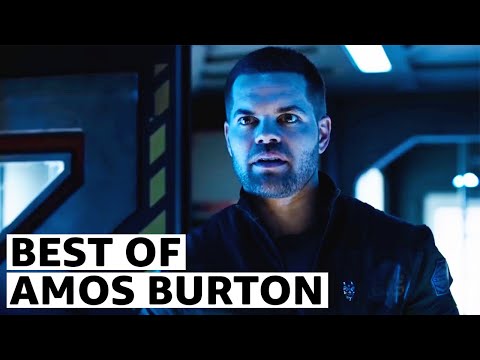
Not yet. The team's talent is real, and so is their commitment to the material. But The Expanse had Amos Burton. It had Chrisjen Avasarala. It had Drummer. Those characters weren't waiting for the writers in the source text: they were the source text.
The Mercy of Gods has a stunning backdrop and a promising lead. Everything surrounding him still needs to be built. And that's precisely what separates a watchable series from one people are still talking about ten years later.
Shankar has said he wants to apply the same approach as on The Expanse: immersive world, strong characters, intense stories, without a bloated budget. The approach is sound. The question is whether the source material gives him enough room to actually pull it off.
The team that brought Amos Burton to life on screen is absolutely capable of creating compelling characters from scratch. They've already done it in reverse, by condensing. The only question is whether they're willing to acknowledge the problem before they solve it.
Because if the series arrives with the novel's worldbuilding and its characters exactly as written, you'll have an extraordinary stage with no one worth watching on it. That's precisely the kind of waste this team knows, better than anyone, how to avoid.