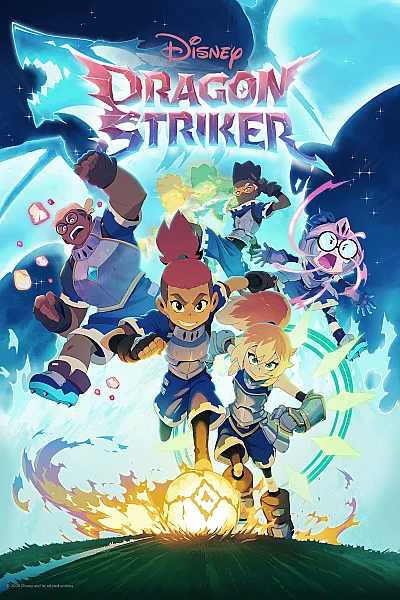

Dragon Striker
Animated in France, scored in Japan
More than a decade of production went into a first season of eleven episodes, released all at once on Disney XD in June 2026. Co-creators Sylvain Dos Santos and Charles Lefebvre invented the sport, the school and the magic system, then handed the score to Kevin Penkin. Penkin wrote the music for Made in Abyss and Tower of God, and he recorded this one in Japan with an eighty-piece orchestra.
La Chouette Compagnie, the French studio behind the animation, keeps the characters in crisp 2D and sets them against backgrounds with far more depth. When the first animation passes disappointed, the team made compositing its main tool, and dust particles, light rays and heavy shadows became the visual identity of the show. Dos Santos and Lefebvre name Final Fantasy, Naruto and Visions of Escaflowne among their references.
The Story
Key Nagatatsu is twelve, lives on a farm, and wants to play gorotama at Kal Asterock, the school that teaches it. The game is close to soccer, except every player also fights with a tama, a personal magical power. Key shows up without one, and the gift he later reveals traces back to his late mother, a champion remembered as the Dragon Striker.
Nothing here adapts a manga, a game or a comic: the world, the sport and its rules were written for the screen. Disney has already renewed the show for a second season of the same length, due in early 2027.
The Ideal Audience
The rating is TV-Y7, and parental guidance sits around eight and up: fantasy violence during matches, some peril outside them, put-downs rather than profanity. Younger viewers get a school-team story, and older ones get a children's sports show scored like a film. We would hand it to a young viewer curious about anime and unsure where to start.
Animated in France, scored in Japan
More than a decade of production went into a first season of eleven episodes, released all at once on Disney XD in June 2026. Co-creators Sylvain Dos Santos and Charles Lefebvre invented the sport, the school and the magic system, then handed the score to Kevin Penkin. Penkin wrote the music for Made in Abyss and Tower of God, and he recorded this one in Japan with an eighty-piece orchestra.
La Chouette Compagnie, the French studio behind the animation, keeps the characters in crisp 2D and sets them against backgrounds with far more depth. When the first animation passes disappointed, the team made compositing its main tool, and dust particles, light rays and heavy shadows became the visual identity of the show. Dos Santos and Lefebvre name Final Fantasy, Naruto and Visions of Escaflowne among their references.
The Story
Key Nagatatsu is twelve, lives on a farm, and wants to play gorotama at Kal Asterock, the school that teaches it. The game is close to soccer, except every player also fights with a tama, a personal magical power. Key shows up without one, and the gift he later reveals traces back to his late mother, a champion remembered as the Dragon Striker.
Nothing here adapts a manga, a game or a comic: the world, the sport and its rules were written for the screen. Disney has already renewed the show for a second season of the same length, due in early 2027.
The Ideal Audience
The rating is TV-Y7, and parental guidance sits around eight and up: fantasy violence during matches, some peril outside them, put-downs rather than profanity. Younger viewers get a school-team story, and older ones get a children's sports show scored like a film. We would hand it to a young viewer curious about anime and unsure where to start.
Reviews
Login to share your review
Comments
Log in to join the discussion
No comments yet. Be the first to share your thoughts!