
Übersetzt aus Englisch
Ein packendes und ambitioniertes Sci-Fi-Abenteuer, das Lust auf mehr macht.
8
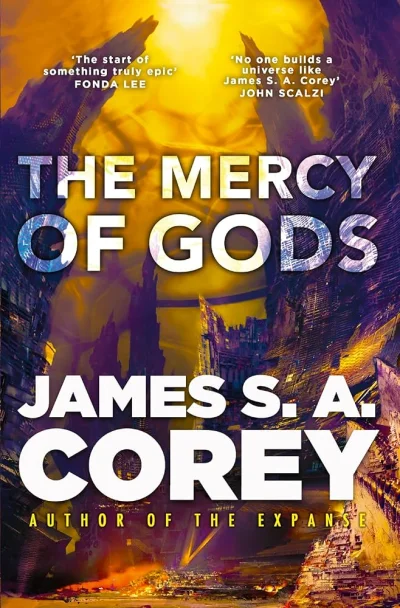

The sky above Anjiin darkens with the arrival of ships no one expected, bringing with them a silence more terrifying than any weapon. It's within this suffocating new order that James S.A. Corey (Daniel Abraham & Ty Franck) crafts a tale of subjugation and quiet defiance, set against the vast backdrop of an interstellar empire's merciless expansion.
On a distant human colony severed from any memory of Earth, life is upended when the Carryx, a conquering alien species driven by a rigid biological caste system, invade Anjiin, slaughter millions, and abduct the planet's brightest minds. Among them is Dafyd Alkhor, a research assistant thrust into captivity aboard a colossal world-city. The Captive's War follows Dafyd and his fellow prisoners as they are forced to prove humanity's usefulness through scientific labor, all while navigating lethal alien politics, a brewing resistance, and the whisper of a far older war that dwarfs them all.
Where The Expanse leaned into solar-system realpolitik and orbital mechanics, this new series embraces the stranger, wilder side of space opera, drawing on influences from Frank Herbert's Dune and Ursula K. Le Guin's The Left Hand of Darkness. Corey's prose remains razor-sharp, but the focus shifts to xenobiology, psychological survival under an incomprehensible alien autocracy, and the moral cost of collaboration. The Carryx are among the most chillingly realized antagonists in modern science fiction, not evil for evil's sake, but operating under a logic that is utterly alien and terrifyingly coherent.
This series is essential reading for fans of The Expanse eager to see Corey push into bolder territory, as well as anyone who loves character-driven space opera with genuine sense of wonder. Readers who enjoy stories exploring what it means to remain human under impossible oppression, in the vein of Octavia Butler or Adrian Tchaikovsky, will find it deeply rewarding. Be warned: the slow-burn tension and a devastatingly ambiguous ending will leave you desperate for the next volume.
The sky above Anjiin darkens with the arrival of ships no one expected, bringing with them a silence more terrifying than any weapon. It's within this suffocating new order that James S.A. Corey (Daniel Abraham & Ty Franck) crafts a tale of subjugation and quiet defiance, set against the vast backdrop of an interstellar empire's merciless expansion.
On a distant human colony severed from any memory of Earth, life is upended when the Carryx, a conquering alien species driven by a rigid biological caste system, invade Anjiin, slaughter millions, and abduct the planet's brightest minds. Among them is Dafyd Alkhor, a research assistant thrust into captivity aboard a colossal world-city. The Captive's War follows Dafyd and his fellow prisoners as they are forced to prove humanity's usefulness through scientific labor, all while navigating lethal alien politics, a brewing resistance, and the whisper of a far older war that dwarfs them all.
Where The Expanse leaned into solar-system realpolitik and orbital mechanics, this new series embraces the stranger, wilder side of space opera, drawing on influences from Frank Herbert's Dune and Ursula K. Le Guin's The Left Hand of Darkness. Corey's prose remains razor-sharp, but the focus shifts to xenobiology, psychological survival under an incomprehensible alien autocracy, and the moral cost of collaboration. The Carryx are among the most chillingly realized antagonists in modern science fiction, not evil for evil's sake, but operating under a logic that is utterly alien and terrifyingly coherent.
This series is essential reading for fans of The Expanse eager to see Corey push into bolder territory, as well as anyone who loves character-driven space opera with genuine sense of wonder. Readers who enjoy stories exploring what it means to remain human under impossible oppression, in the vein of Octavia Butler or Adrian Tchaikovsky, will find it deeply rewarding. Be warned: the slow-burn tension and a devastatingly ambiguous ending will leave you desperate for the next volume.
Melde dich an, um deine Meinung zu teilen

Melde dich an, um mitzudiskutieren
No comments yet. Be the first to share your thoughts!

Kommentare (1)
Melde dich an, um mitzudiskutieren